The door behind me hadn't moved.
On the tracing paper, the two heads were still turning. Pencil lines beside their necks were erased and put back, as if someone wasn't sure how to draw shoulders when a person looked behind them.
I reached for the lock.
"Don't go out yet," my son said.
"I'm checking it's locked."
"You've checked three times."
I brought my hand back. What I'd been touching wasn't the lock at all. It was my own key, still in my trouser pocket.
He didn't laugh. He took the mug off the table, moved the phone aside and found a clean receipt to put beneath the tracing paper. I thought he was worried about getting it wet. Then I saw he'd already drawn a table on the back of the receipt.
Two circles were us.
"What are you doing?"
"Testing whether it can actually see us."
I'd been preparing a long explanation: perhaps it was a mirror, perhaps it was ten years ago, perhaps the notebook had recorded the moment just past. He'd already laid his pencil across the page behind the two circles.
"Sit down again first."
I sat. On the paper, the person with glasses slowly sat down too.
He asked me to raise a hand. I raised my left. A hand rose on the paper, its fingers like five bamboo skewers.
"Looks just like you."
"The hand?"
"The belly."
At last he laughed. Somehow, hearing him laugh made me realise I'd been holding my breath.
He lifted his pencil and put it down, twice. A short line on the tracing paper rose off the table and returned with it. The third time he stayed still, and so did the line. We hadn't counted seconds. We didn't know the delay. Only that these few movements didn't carry on by themselves.
"So someone behind us is watching us?"
He didn't answer. I pointed at the door; he turned the receipt towards me.
Behind our two circles he'd drawn two lines, bracketing the lamp and mug. He pushed the mug closer to the lamp's base, crouched a little and closed one eye.
"Tell me what you need me to do first," I said.
I used to tell him to start with the result, not take me from the first school break to the end of the day before telling me where he'd dropped his pen. Now, with him looking at me, I wanted him to keep talking. Long enough, if possible, to drown out anyone knocking.
"Stand up. Go over by the window. Leave the chair."
I did.
On the tracing paper, the back of the person with glasses moved to the left. The chair stayed put. A short extra line appeared beneath one leg, then beneath the other.
I looked at our front door again.
"Not the door. Look at the chair."
The chair on the paper was half as tall.
I hadn't misjudged the scale. The lamp, the mug and my son hadn't shrunk. Only the chair I'd just been sitting on had become a little short-legged wooden chair. Two horizontal rails across the back. A notch in the lower one.
The backs of our dining chairs had vertical slats.
He smoothed the tracing paper out. A crease covered one corner, but the notch was perfectly clear, as if someone had bitten a piece out of it.
"Do you remember?"
"Your little old chair."
"I meant, did you saw that notch out?"
I looked at him. He pointed his pencil at his knee.
"It used to scratch my legs."
I remembered. Not a tooth mark. I'd sanded away a split corner, badly, leaving a crescent-shaped hollow. When he ate, his feet hadn't reached the floor. He used to rock on that chair. I'd tell him to sit properly while bracing it with my other foot.
It had been a long time since I'd remembered how I used to sit.
"Have we still got it?" he asked.
My first response was that I didn't know. By the time I'd answered, he'd already gone to the cupboard, bent down and started pulling something out from between a folding chair and some paper bags.
I switched on the light for him. He turned his phone towards me. On the screen was a wooden corner at the bottom of the cupboard.
"I looked earlier. Couldn't get it out. Hold the stuff above it for me."
While I'd been feeling around in my pocket, he'd already been looking.
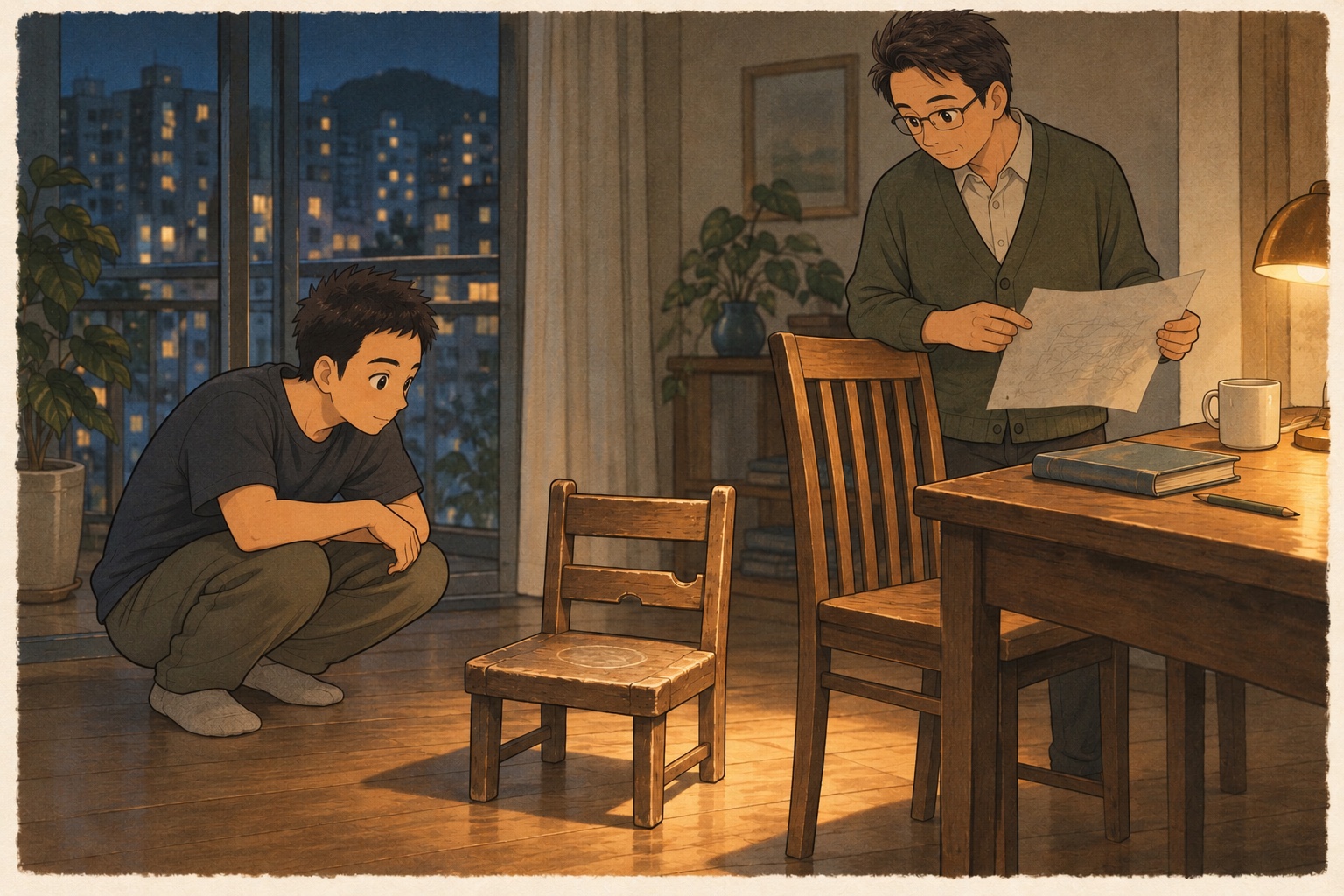
The little chair was still there. Only when we brought it out, so low to the ground, did I realise how small my son had once been.
We placed it by the table. I reached to move the original dining chair away. My son held its back.
"Don't swap them yet. One thing at a time."
So the two chairs stood side by side, one tall, one small, as if dinner were about to be served and someone had misremembered a guest's age.
He checked the position with his toe against a line between the floor tiles, asked me to hold the tracing paper and stepped back to his place. The dining chair hadn't moved. The mug was still beside the lamp. I was going to ask whether to bring it closer, but he raised a hand, and I stopped.
The little chair's paint had worn smooth. There was a faint circular mark on the seat. I rubbed it with a finger. It wouldn't come off. Then I remembered a plastic bowl he used to turn upside down on it.
The tracing paper didn't change at once.
We waited. A drop of water fell by the door and I flinched. My son looked over and pointed at the wet umbrella I'd hung there. Water spread slowly across a floor tile.
"Next time, tell me it's the umbrella first."
"You said one thing at a time."
I was about to argue when a third chair suddenly appeared on the tracing paper.
The tall chair was at the side, the little one in the middle. Someone kept going over the crescent-shaped notch with a pencil, so dark it almost seemed to pierce the paper.
My son pushed the receipt towards me. He didn't add another circle. Along the edge of the table, he marked out one small place.
I remembered the way he'd once turned his screen towards me. I was always assuming that if I hadn't taught him yet, he hadn't started. Tonight, before I'd even made clear what we should test, he'd already helped me keep several different things separate: me, the chair, and whoever had sat on it in the drawing.
But the place being kept might not be for me.
I opened the diary.
The door was still shut. The little figure beside it had stopped rubbing his wrist. He drew a semicircle with a few short lines beneath it.
My hand was already reaching for the eraser.
My son moved it further away.
"Don't change his drawing again."
I stopped. After looking a little longer, I saw that the lines beneath the semicircle weren't hair. They were chair legs. The chair was on its side. Once again, I'd mistaken it for something else.
In an empty space, I drew the little chair facing forwards, notch and all. No arrow. No beckoning hand. When I'd finished, I laid the pencil at the edge of the table.
The tipped-over chair on the other side was slowly erased.
Much later, a circle appeared below the door handle. I couldn't tell whether it was a hand, a lock or something else only half drawn.
I didn't change it.
My son went to the kitchen and brought back another cup. He looked at the little chair, then set the cup between us, without pouring any water.
"Shall we wait a bit?" he asked.
I nodded, sat back on the tall chair and planted my feet properly, no longer bracing the little one.
On the tracing paper, beside the third cup, two small children's shoes appeared.
Their toes pointed down. They didn't reach the floor.
I looked back at the table.
The little chair was still empty.
End of Letter Three