The light inside the door shone onto my son's hand.
It wasn't yellow pencil. He covered the page, and the lines showing between his fingers were actual light.
"What strange thing have you bought now?"
"I bought this notebook ten years ago."
He moved his hand away. Half a shoe had appeared inside the door. A child's shoe, its toe pointing outwards. A black dot beside it was slowly growing.
I picked up a pen to ask where the other person was. The tip travelled half an inch without leaving any ink. Then I remembered: I'd already used today's line.
My son looked at my hand, then at the question I'd written at the start: "What year is it where you are?"
"You get one line, and you used it to check his details."
"I didn't know the next sentence would cost so much."
He didn't smile again. The shoe drew back a little. The black dot in the doorway stretched into a hand.
I pulled the notebook closer.
"Wait. Don't move."
Only after saying it did I realise I was talking to a sheet of paper again.
The door was open just a crack. Whoever was drawing it seemed to be in a hurry. The frame, the hinges, the fingers took turns appearing and being erased. Pencil dust gathered at the foot of the page, as if someone had wiped it with a dirty finger.
I drew a hand knocking on the door.
The hand on the other side immediately pulled back.
My son looked down at my drawing.
"Your hand's bigger than the whole door."
I rubbed it smaller. Three fingers remained. It looked like a crab tapping on the door.
"Maybe stop helping for a moment," he said.
I put down the pencil, but not the notebook. The frame kept tilting. Just when I could make sense of it, it became an open suitcase again. I turned the notebook, and the lines on the other side twisted with the angle, until I wasn't even sure which way was up.
I tried taking a photograph. The phone captured only an ordinary pencil drawing. The light was still there, but not on the screen. When I looked up from the photograph, the handle had changed position.
My son reached into a drawer and took out a stack of notebooks and a few thin sheets of paper.
"You've still got these?"
I recognised them. The paper I'd given him to lay over a copybook and trace when he was learning to write. There was a grease stain in one corner, left by some long-forgotten breakfast.
"Useful things."
He glanced at the whole drawer.
"Well, one of them is, today."
We laid the tracing paper over the page. The door was still visible underneath. The light passed through both sheets, a little fainter.
My son held the pencil and began tracing the frame. I held two corners down.
"Quick. It's moving again."
For some reason, I started the stopwatch on my phone. When we used to race at handwriting, I'd filled a page in three minutes and nine seconds. Ever since, the sight of him holding a pencil seemed to make me glance at a clock.
He reached the second corner and stopped.
"Dad, do you want it accurate, or fast?"
I looked at the running numbers and stopped the timer.
Between the sheets, one section of line slowly left its place. On top was the frame he'd traced. Below it, the original door was leaning away in another direction.
He lifted the tracing paper half an inch, then put it down again.
"This top one doesn't have to move with it."
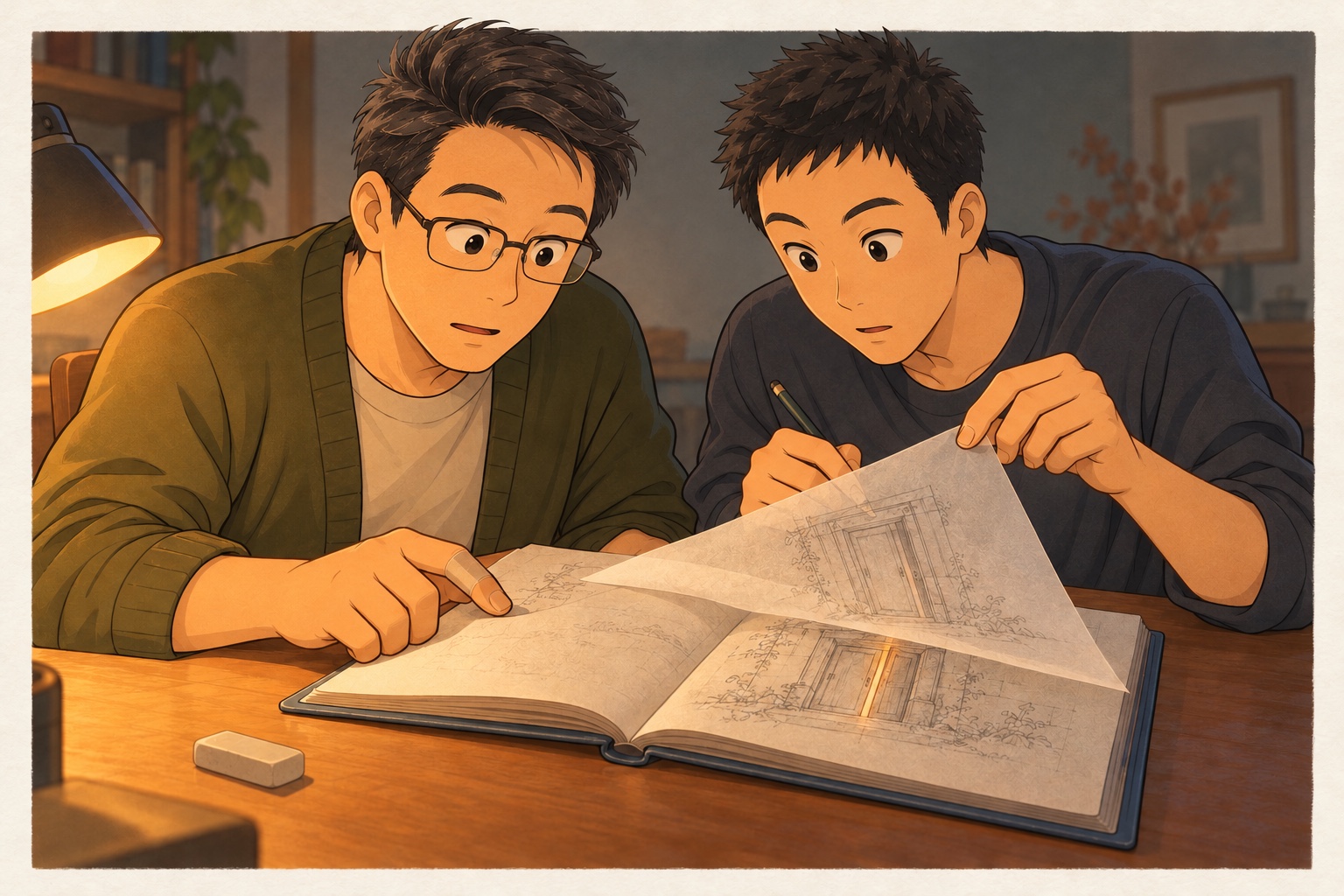
At last I could see. The two circles I'd mistaken for wheels were a handle and a screw in the hinge. The little square really was a window. Behind it, a hand was pressed against the glass, all five fingers spread.
But the child's hand inside the doorway was holding the handle.
I picked up the pencil and drew along the door on the tracing paper, trying to open it wider.
The door underneath suddenly shook.
The hand behind the window pressed closer.
My son caught my wrist.
"Not opening."
I stopped.
He pointed his pencil at a fine line beside the handle.
"Look at the elbow. He's pulling it shut."
We'd spent the whole evening trying to see what was behind the door. The child on the other side might only have been trying to close it.
I rubbed out the line I'd just added. As the eraser passed over the tracing paper, a faint tremor came from underneath. My son let go of my wrist and pressed both hands onto the notebook instead.
"Don't pull the paper."
The more urgently I tried to fix it, the harder I rubbed. The tracing paper crumpled. A little patch near the handle stuck to the page below. Afraid of tearing it, I stopped. One of the five fingers behind the window had curled around the frame.
My son took the eraser away.
"Lift the top sheet first."
I tried the left corner. It wouldn't lift. The right corner came loose, but the left stayed caught. The plaster on my finger was snagging the edge. Only then did I realise how hard I was pressing.
Slowly, I loosened my grip.
As the paper came free, the door in the diary slammed shut. There was no sound. But the mug on the table shook, and its handle knocked against my phone.
The light went out.
Neither of us spoke. He kept his hands on the notebook, as if the door might spring open again.
After a long while, a little figure appeared beside the door, kneeling, one hand clasping the other wrist.
I knew that gesture. When handwriting tired his hand, he used to let it hang, shake it twice and rub it with the other hand. Back then, I always asked: how many lines left?
Today I didn't draw a clock. I drew a hand that had put its pencil down, then laid my own pencil on the table.
The little figure sat down. After a while, he drew a big-bellied dad beside himself.
The belly was a little smaller than before.
I didn't dare make any corrections. I took it as good news.
We closed the diary without putting it away. It stayed between our two chairs. Neither of us got up.
"Who did you think you were helping?" my son asked.
I looked at the eraser. A few thick, dark pencil shavings clung to it.
"I thought we'd know more if it opened wider."
He didn't answer. He just smoothed out the sheet on which he'd traced the door. The creases were still there. So was the frame, at the angle it had held before the door closed.
I reached to tuck it into the diary. Suddenly he said, "Wait."
He held the tracing paper up to the desk lamp.
Below the window were lines I hadn't drawn and he hadn't traced. At first they looked like two posts and a crooked box.
He turned the paper.
Not posts. Two people's backs.
Not a box. Our table.
One person wore glasses. The other's fingers were stained with pencil dust. Between them lay a closed notebook.
Slowly, I turned my head. Behind us was the closed door of our home.
On the tracing paper, the two people slowly turned their heads too.
End of Letter Two