I bent down and looked under the little chair.
No feet. No shoes. Just a tuft of dust trapped beneath one chair leg. On the tracing paper, though, the shoes swung gently, one ahead of the other. A strip of blank paper remained below their toes, as if a child were sitting far back in the seat, unable to reach the floor however hard they stretched.
“Don't push the chair,” my son said.
My hand stopped on its back. I had been about to pull it closer again.
“I want a better look.”
“If you move it, we won't know which thing made the picture change.”
I sat back on the tall chair, trying not to touch the little one beside it. When we used to eat together, one foot was enough to hold it steady. Now the chair was empty, yet I had no idea where to put either of mine.
The third cup still had no water in it.
The shoes on the paper swung three times and stopped. I counted a fourth before realising I had added it in my head.
Two short lines crossed the tops of the shoes. Laces, perhaps. I leaned closer, and my son tilted the tracing paper a little towards me without pulling out the receipt beneath it. Lamplight passed through the paper fibres; the edges of the soles faded almost to nothing. I drew back and could see them again.
For a moment I badly wanted to hand him the paper and go to the kitchen to boil some water. As long as someone kept watching, perhaps I could pretend to step away. But he was still holding the other corner. I didn't ask him to keep an eye on it for me.
I knocked twice on the table with my knuckles.
A solid sound travelled back through my hand. The tracing paper didn't tremble. The cups didn't move.
“Can he hear that?”
My son didn't answer. First he closed the cover of his phone case and pushed it farther away.
When no reply came, I made to knock again. He raised a hand.
“Listen first.”
Suddenly the flat was full of sounds. The fridge stopped, and the rain at the window became clearer. Something scraped across the floor upstairs. The umbrella by the door dripped; this time I didn't flinch. After a while my son's shirt brushed the chair back. I could hear even that.
The diary stayed silent.
I opened my phone and found the old blog post about his drumming. I'd written that he had stuck with piano for two years without practising, then tried the drums. My tone had been so casual, as if changing instruments were much like changing pencils.
My son saw the title.
“You're not going to test me now, are you?”
“I want to know if this is what you used to play.”
I tapped the edge of the table a few times. The first two beats were even. I fell behind on the third, then hurried the fourth to catch up and hit my own plaster.
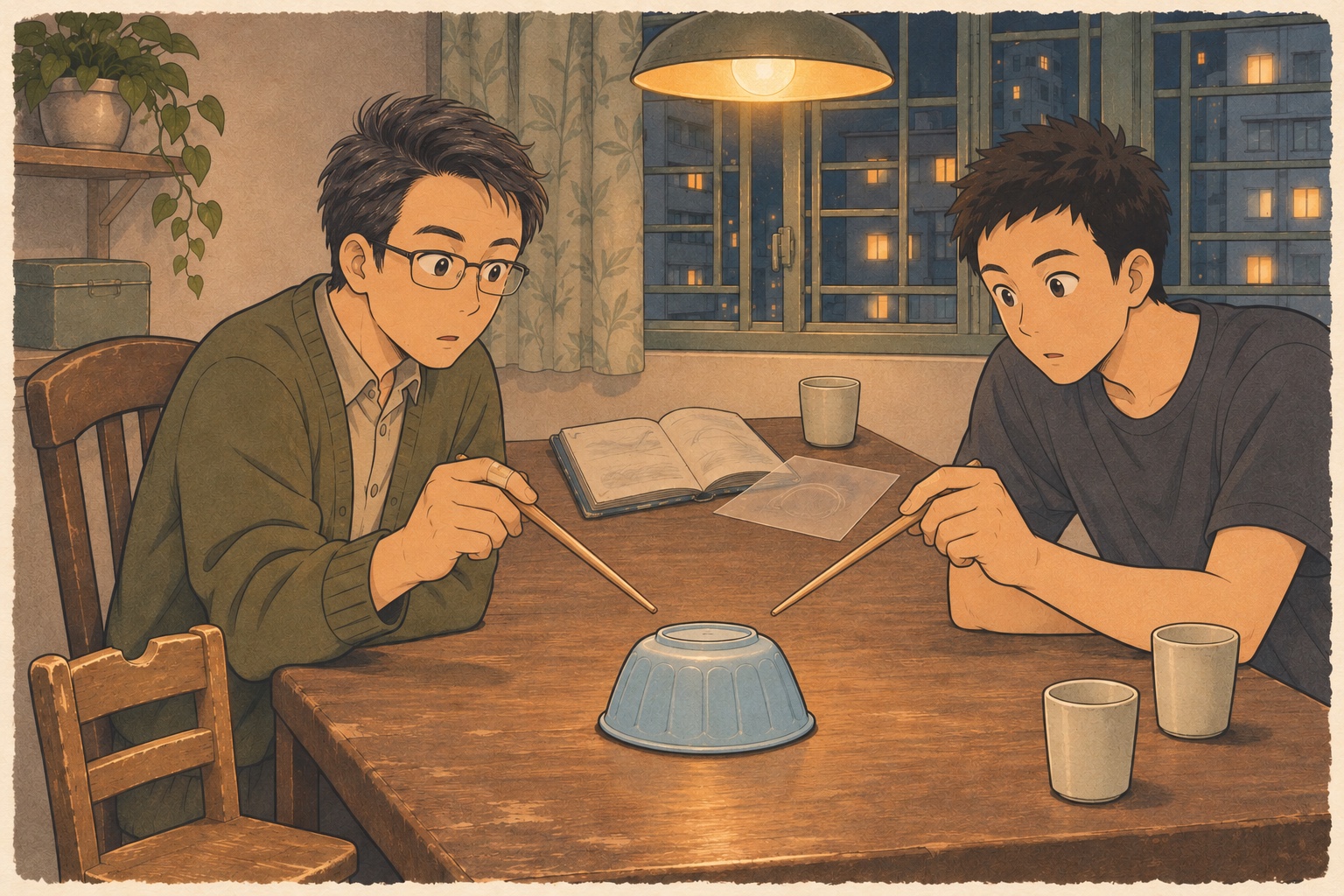
He laughed, pulled open a drawer and found a clean pair of chopsticks. I fetched a plastic bowl from the kitchen and placed it upside down near the table edge, a little way from the diary.
He didn't start tapping straight away. First he handed me one of the chopsticks.
Twice on the bottom of the bowl. Once on the rim.
The sounds were small. The bottom was dull; the rim a little clearer. Like a sentence with two words mumbled, only the last one spoken properly.
I copied him.
“Not so fast.”
I slowed down. After the third tap my hand rose on its own, ready to add a fourth. His chopstick hung in mid-air. I stopped too.
Half a beat left empty.
The rain moved through the gap.
“Did you miss one?” I asked.
“I just didn't play it.”
He played it again and stopped in the same place. This time I didn't fill it in. I couldn't tell whether he was showing me a rhythm he'd learnt years ago or one he'd just invented. But leaving that beat unplayed seemed harder than getting it right.
On the tracing paper, both shoes stopped.
I nearly cried out. My son put down his chopstick and pointed at the paper.
“They stopped before, too.”
I looked at him and slowly let out the breath I'd already drawn in. We had tapped; the shoes had stopped. That still didn't mean anyone on the other side had heard us.
I wanted to try again, but a small stretch of pencil line was being rubbed away in the diary.
The circle below the door handle grew thicker.
I turned the diary towards the lamp. A second curve appeared beside the circle, then a short lip. It looked less like a lock now. More like a bowl seen sideways.
The little figure on the page went to the door, raised the object and held it close to the windowpane.
I glanced at the upside-down plastic bowl on our table.
“Does he want to play too?”
My son leaned over to look at the figure's hand.
“He hasn't got any chopsticks.”
The figure opened the other hand, palm towards us. Five lines of different lengths. The shortest had to be drawn twice before it stayed. I remembered the large hand behind the window earlier, and my fingertips went cold.
But this hand was much smaller. It hadn't reached out past the window frame either.
I didn't draw a hand in reply, let alone try to write. Today's used-up line was still at the top of the page. Being impatient wasn't going to earn me an extra half-sentence.
My son gently slipped the chopstick from between my fingers.
I expected him to play the rhythm again. Instead he laid both chopsticks side by side next to the bowl.
“What are you going to do?”
“Wait till he's finished.”
I watched the little figure. He shifted the bowl a little away and tilted his head to the other side. His palm stayed open. Nothing else was drawn.
When I used to listen to my son read, I often wanted to supply whatever word he got stuck on. Slow in Chinese, quick in English: my mind would automatically compare the two speeds. Writing it up on the blog, I'd thought I was simply recording how lovely his reading sounded.
Now I didn't even know whether the person on the other side wanted to make a sound, and I was already preparing to keep time for him.
I put both hands back on my knees.
After a while, the bowl on the page began to move down.
The figure crouched and held the rim close to the bottom of the door, lowering his head with it. The door didn't open. At last the outstretched hand came back and pressed against the ground.
My son and I both looked at our own front door.
No one knocked.
I was about to stand when he tugged my sleeve and pointed at the tracing paper. The little shoes no longer pointed down. One had tipped up, exposing a small patch of sole.
Whoever was sitting there seemed to be bending down.
I bent down again. There was still nothing under the little chair. The tuft of dust lay against the same line of grout.
My son didn't ask what I could see. He crouched on the other side, both our heads below the tabletop, as if we were looking for a dropped chopstick together.
At the first sound, I thought my knee had struck the wood.
The second sounded closer.
I opened my hands for my son to see. Slowly, he opened his too. None of our four hands was touching the table, a chair or the bowl.
The third sounded beneath the empty chair.
Dull, dull. A little clearer.
Then half a beat left empty.
My finger rose. Stopped.
This time I didn't fill it in.
End of Letter Four